

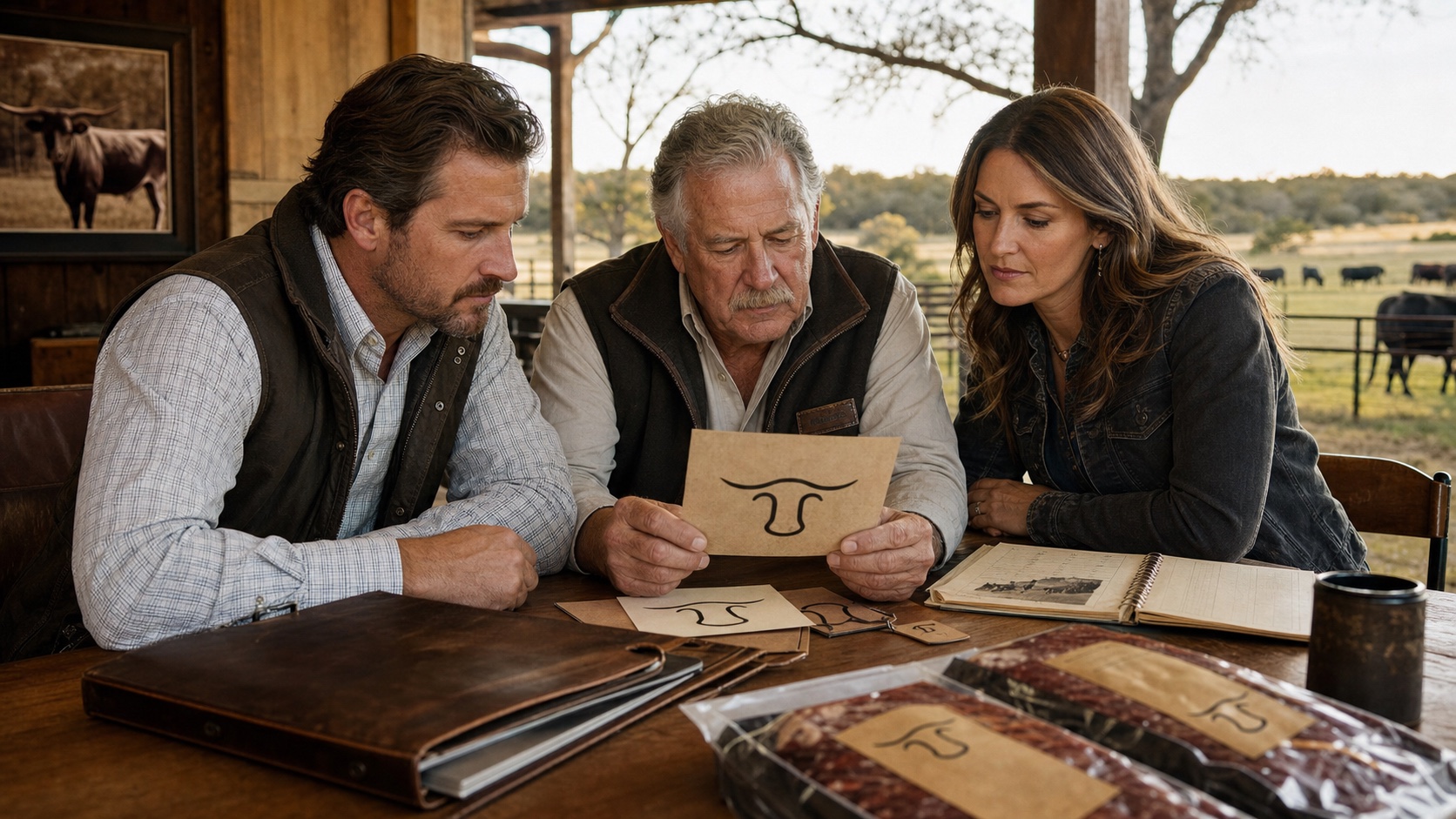
A second-generation Texas ranch family has turned a cattle operation into a branded beef business. The founder spent thirty years building a direct-to-consumer label that restaurants and grocery buyers now ask for by name, the son runs the cattle side, and the daughter manages the accounts. A private buyer has signed a letter of intent at a price that reflects the brand, not just the land and the herd, which would fund two retirements and a meaningful inheritance.
Then, in week two of diligence, the buyer’s counsel sends a short memo.
The trademark on the beef label is registered to the founder personally, not to the company. The genetics and feeding program behind the product’s consistency, the asset the premium price leans on, exists nowhere on paper. It lives in the founder’s head and in the daily judgment of one longtime foreman who has no confidentiality agreement and no retention incentive.
The deal might not die that day, but it likely gets significantly repriced (and not in your favor).
Suddenly, the buyer’s team starts talking about a larger escrow, a longer earnout, and a lower headline number, because the assets they thought they were buying turn out to be harder to own than anyone in the family realized!
Step back from the scenario, and the pattern gets bigger.
Intangible assets represented roughly 92% of the market value of the S&P 500 at the end of 2025, up from 17% in 1975.1 The economy has spent fifty years moving value out of buildings and equipment and into brands, processes, software, data, and know-how.
Family companies rode the same shift, but with one important difference. Public companies employ legal teams whose job is to register, document, and defend those intangibles. In a family enterprise, the same category of asset is often the least protected wealth the family owns.
That gap is the subject of this article. If you own a business that represents a meaningful share of family wealth, whether it’s a Texan ranch with a branded program or a storefront name customers in Sarasota have trusted for decades, the planning question is as follows: does the company legally own the intangible assets that drive its value, and can those assets survive a sale, a succession, or an estate settlement intact?
The Shift From Tangible to Intangible Value
When owners think about what their company is worth, the mind goes first to the visible items: the building, the equipment, the inventory, the receivables. Those assets are easy to count and easy to insure, and in most modern businesses they explain a small fraction of the price a buyer will pay.
What a buyer is often paying for is the earning power that sits on top of the physical assets. The brand customers ask for by name. The recipe, formula, or process competitors haven’t matched. The database the operation runs on. The customer list and the contract relationships. The accumulated know-how that lets the company produce at a margin others can’t reach. In valuation terms, these intangibles are most of the spread between book value and enterprise value, which is why a company can trade at a multiple of earnings that far exceeds anything on its balance sheet, and why two companies with identical equipment lists can sell for very different prices.
An asset can drive value without being owned in any legal sense, and a buyer, successor, or an estate can only receive what the company can prove it actually owns.
The Five Types of Family Enterprise IP
Intellectual property sounds like a topic for technology firms, but many established family companies hold assets in at least one of four legal categories.
Trademarks protect the brand: the company name, product names, logos, taglines, and packaging that customers recognize. Rights arise from use, but federal registration makes them far easier to enforce, license, and sell. Trade secrets protect confidential information that has value because it’s confidential, such as recipes, formulas, processes, pricing models, and customer data. They’re protected under federal and state law, but only if the company takes reasonable steps to keep them secret.
Copyrights protect original content, including marketing materials, photography, packaging artwork, training manuals, and custom software. Patents protect inventions and processes, and while they’re less common in family businesses, a company that developed its own equipment modifications or production methods may hold patentable assets it never filed on.
Five Forms of Family Enterprise IP

1 Trademarks Names, logos, packaging, and brand recognition
What it coversNames, logos, taglines, packaging, and the brand customers recognize.
Buyer looks forRegistrations, renewals, ownership records, and licensing terms.
2 Trade Secrets Confidential processes, formulas, pricing, and data
What it coversRecipes, formulas, processes, pricing models, and confidential data.
Buyer looks forRestricted access, confidentiality agreements, and documented controls.
3 Copyrights Creative work, training materials, and software
What it coversPhotography, packaging artwork, training materials, content, and software.
Buyer looks forWritten assignments from employees, family members, and contractors.
4 Patents Inventions, equipment changes, and production methods
What it coversProtectable inventions, equipment modifications, and production methods.
Buyer looks forFiled rights, clear title, inventor assignments, and maintenance records.
5 Know-How Operating judgment, relationships, and experience
What it coversSupplier knowledge, quality judgment, operating experience, and relationship knowledge.
Buyer looks forDocumentation, training, retention plans, and a credible transfer process.
A buyer can only underwrite what the company can identify, document, control, and transfer.
Around those four categories sits a fifth, informal one that carries much of the value in a family company: know-how. The founder’s supplier relationships, the feel for quality control, the judgment about when to buy inventory. Know-how can’t be registered, but it can be documented, taught, and tied to the business through employment agreements, training programs, and succession planning. Left undocumented, it walks out the door with whoever holds it.
Domain names, social media accounts, phone numbers, and online review profiles belong on the list as well. They aren’t traditional IP, but buyers treat them as part of the brand, and families are often surprised to find them registered to an individual’s personal email account rather than to the company.
Common IP Exposures in Family Businesses
The exposures in family enterprises follow a predictable pattern, and many of them trace back to informality that made sense when the company was small.
The first problem is personal ownership. The founder registered the trademark, the domain, or the patent in their own name decades ago, and nobody revisited it as the company grew. That structure creates three separate risks. In a sale, the buyer discovers the company doesn’t own its own brand and demands assignments, consents, and sometimes price protection. In a succession, the IP passes through the founder’s estate rather than with the company, which can strand the brand with heirs who aren’t in the business. And in the meantime, the arrangement muddies any entity-level asset protection the family thought it had.
The second problem is unclear copyright ownership. Family members, employees, and outside contractors created logos, software, content, and product designs over the years, often without agreements that establish who owns the work. Work an employee creates within the scope of employment generally belongs to the employer. An independent contractor is different: the contractor generally keeps the copyright unless the work fits one of the narrow work-made-for-hire categories and both sides signed the right agreement up front, or the contractor later signed a written assignment.2 The nephew who built the website may legally own some or all of it.
The third problem is poorly protected trade secrets. A recipe or process can qualify for trade secret protection whether it’s written down or carried in someone’s memory, but only if it draws its value from staying outside general circulation and the company takes reasonable measures to keep it secret.3 Restricted access, confidentiality agreements, and sensible security controls are the usual ways to demonstrate those measures. A breeding and feeding program known only to the founder and one foreman may still qualify, but without documentation, access controls, or a transfer plan, it doubles as a serious key person and succession risk.
The fourth problem is the unregistered mark. Plenty of family companies never registered their name because everyone in their market already knows them. Local reputation carries weight, but it’s geographically limited and hard to enforce. If a competitor registers a similar mark first, or if the buyer’s counsel finds a conflicting registration in another state, the brand the family spent decades building becomes a diligence issue instead of a selling point.
IP in the Buyer’s Diligence Process
Buyers scrutinize intangibles closely, precisely because intangibles are often most of what they’re paying for. The diligence request list will ask for a schedule of all registered IP, the chain of title on each item, assignment agreements from every employee and contractor who created protectable work, confidentiality agreements covering trade secrets, and any licenses, disputes, or claims involving the company’s IP.
Clean answers speed the deal. Messy answers change its economics. When ownership is unclear, buyers respond with tools that shift risk back onto the seller: purchase price reductions, larger escrows and holdbacks, expanded indemnification, and earnout structures that make the family keep earning money they thought they had already banked. In some cases, unclear IP ownership could push buyers to walk away entirely rather than inherit a future dispute.
The timing makes this worse. Many owners first confront these questions after a letter of intent is signed, when leverage has already shifted to the buyer, and every fix happens under deadline pressure. Assignments that would have been routine paperwork five years earlier now require negotiating with a former contractor who understands exactly how much leverage they hold.
The better sequence is to treat IP cleanup as part of getting the company ready before it goes to market, alongside the clean financials, the transferable contracts, and the management depth a buyer will test anyway. A family running a branded beef program can fold the same work into a pre-sale review of the whole operation, so the brand and the process get the same attention as the land, water, and equipment.
Two Versions of the Same Closing Table
Documented IP
Headline price holds through diligence
Standard escrow and indemnification terms
Shorter, cleaner earnout structure
Diligence moves on schedule
Unclear IP
Price reductions to absorb ownership risk
Larger escrows, holdbacks, and indemnities
Longer earnouts that defer the family's proceeds
Delays, renegotiation, or a dead deal
Simplified comparison for education. Actual deal terms depend on the transaction, the buyer, and the assets involved.
IP in the Succession and Estate Plan
Even a family with no intention of selling has the same problem in a different costume. One frequently cited study estimated that only about 30% of family businesses remain under family leadership and control through the second generation, a figure that counts continued family ownership rather than successful sales or planned exits.4 However the odds are measured, the handoff is where untitled assets slip away. A successor can inherit the stock of a company and still lose the brand if the trademark sits in the founder’s personal estate, or lose the process if the only person who knew it retired without documenting it.
The first step is titling. IP that drives company value generally belongs in the company, or in a holding structure the family controls, rather than in an individual’s name. Where the family already uses an entity structure for the business, the same logic that governs choosing between a family limited partnership and a family LLC applies to the intangibles: get the asset into a structure that can be governed, valued, and transferred in interests rather than in pieces.
The second step is recognizing that IP is a transferable estate asset in its own right. A registered trademark, a patent, or an interest in an IP holding entity can be appraised and transferred by gift, though asset-specific rules apply; a trademark, for example, generally has to move together with the goodwill behind it.5 Under current law, the federal estate and gift tax exemption is $15 million per person in 2026, with no scheduled sunset and inflation indexing beginning in 2027, and married couples may be able to combine exemptions of up to $30 million with the right planning.6 That gives many families room to move brand and IP interests into trusts while the exemption is generous and, in many cases, while the value is still growing. Gifting an interest in an IP holding entity to a dynasty trust, for example, can move future appreciation in the brand out of the taxable estate while the family retains management of the business that uses it.
However, IP is hard to value, and the IRS knows it.
Transfers of brand or IP interests should be supported by a qualified appraisal built on methods that fit the specific asset, such as expected income, comparable royalty rates, and remaining legal or economic life where it applies, because a thin valuation invites scrutiny.
Trademarks also carry ongoing duties once they sit in a trust. If the trust licenses the mark back to the operating company, the owner should document quality standards and enforce them in practice, since uncontrolled licensing, what trademark lawyers call a naked license, can jeopardize the rights themselves. Trade secrets require similar care: they can be assigned, but the assignment should identify them on a confidential schedule with access limited to the people who need it, because a public filing that discloses the substance of a secret can destroy the secrecy the protection depends on.
Moving the Brand Into the Estate Plan
Title It
Move IP out of personal names and into the company or a family-controlled holding entity.
Appraise It
Support any transfer with a qualified appraisal using methods that fit the specific asset.
Gift It
Transfer interests into trusts while the exemption is generous and the value is still growing.
License It Back
Document and enforce quality controls so the operating company can use the brand without jeopardizing it.
Simplified sequence for education. The right structure depends on the asset, the entity, and the family's estate plan.
Handled well, these steps reinforce each other. The same documentation that satisfies a buyer’s diligence team makes a gift appraisal defensible, and the same titling work that protects the brand in a sale keeps it out of a contested estate. Families that treat estate strategy as part of running the business usually find that IP is the piece that ties the business plan and the estate plan together.
In Conclusion
In a family enterprise, the most valuable asset is often the one that never appears on the balance sheet: the brand, the recipe, the process, the accumulated know-how that lets the company earn what it earns. Those assets can drive a sale price, anchor a succession, and fund a legacy, but only if the company can prove it owns them and only if the family has a plan for how they transfer.
The work is unglamorous: retitling assets that sit in personal names, papering the assignments that were never signed, documenting the trade secrets and controlling who can see them, and registering the marks the market already associates with the family. Once that foundation is in place, the results can be folded into the estate plan, so the intangibles that built the wealth carry it forward under a structure the family controls rather than one an estate settlement improvises.
None of this happens well under deal pressure, and none of it works in isolation. IP protection touches the sale price, the succession plan, the estate tax exposure, and the retirement the business is supposed to fund, so it deserves coordination across IP counsel, the valuation team, and the wealth plan. If your company’s value rests on assets nobody has ever titled, appraised, or assigned, schedule a review with our team, and we’ll help you put the plan around them.
Sources
- Ocean Tomo, Intangible Asset Market Value Study (2025 results)
- U.S. Copyright Office, Circular 30: Works Made for Hire
- 18 U.S.C. § 1839, Trade Secret Definitions (Defend Trade Secrets Act)
- Family Business Consulting Group, “Family Business Survival: Understanding the Statistics” (July 1, 1999)
- 15 U.S.C. § 1060, Assignment of Trademarks
- Arnold & Porter, Increases to the Federal Estate and Gift Tax Exemption Under the One Big Beautiful Bill Act (July 2025)
Disclosures
Different types of investments involve varying degrees of risk, and there can be no assurance that any specific investment or strategy will be suitable or profitable for a client’s portfolio. All investment strategies have the potential for profit or loss. Information presented is believed to be factual and up-to-date, but we do not guarantee its accuracy and it should not be regarded as a complete analysis of the subjects discussed. All expressions of opinion reflect the judgment of the author/presenter as of the date of publication and are subject to change and do not constitute personalized investment advice.
A professional advisor should be consulted before implementing any investment strategy. WealthGen Advisors does not represent, warranty, or imply that the services or methods of analysis employed by the Firm can or will predict future results, successfully identify market tops or bottoms, or insulate clients from losses due to market corrections or declines. Investments are subject to market risks and potential loss of principal invested, and all investment strategies likewise have the potential for profit or loss. Past performance is no guarantee of future results.
Please note: While we strive to provide accurate and helpful information, we are not Certified Public Accountants (CPAs). The information in this article is intended for informational and educational purposes only and should not be interpreted as tax advice. It is crucial to consult with a CPA, tax professional or estate attorney to discuss your personal situation.